

Security should not obstruct the working day
A modern facility may have hundreds of staff moving between workshops, warehouses and office areas. People carrying tools or goods may find it inconvenient to stop and present credentials repeatedly. The challenge is to maintain effective authorisation while making identification easier at busy access points.
What touch-free access control means
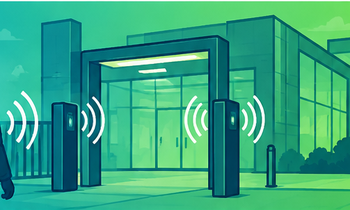
A touch-free access control system uses a compatible tag and reader to identify a person or vehicle within a configured detection area. With appropriate integration, the identification event can be checked against existing permissions. Identification is not the same as granting access: door controllers, policies and security rules must still decide whether entry is permitted.
Where an RFID access control system helps
Busy staff entrances, operational corridors and designated vehicle gates are natural candidates. Suitable active RFID tags can allow hands-free identification within supported reader zones. Some applications also benefit from direction sensing to determine whether a tagged person is entering or leaving a monitored area.
More than door access
A time and attendance RFID system can use identification events to support recording when authorised personnel arrive or leave, subject to appropriate software and workplace policies. RFID car parking access control is another possible application: configured readers can identify compatible tagged vehicles or drivers at monitored entry and exit points.
Why integrators should consider CypherTag
CypherTag offers fast, long-range identification of multiple tags, optional direction sensing and interfaces intended for integration with access control systems. This can offer installers a potential extension to existing customer projects where touch-free identification solves a real operational need. Product selection and compatibility require technical review.
A secure, practical deployment
Before implementation, assess credentials, lost-tag processes, data protection, tailgating risks, system integration and fallback procedures. A pilot at one suitable entrance can establish read reliability, throughput and user experience without prematurely replacing established infrastructure.
Identify where conventional cards create friction
The most compelling use cases for touch-free access control are not necessarily the most prestigious buildings. They are locations where people or authorised vehicles pass through the same controlled point repeatedly and where stopping to present a credential causes delay or inconvenience. A factory worker carrying tools, a warehouse employee moving between zones or a vehicle approaching a controlled barrier may all benefit from hands-free identification. Before specifying a system, measure peak traffic, existing access delays and the number of exceptions staff must handle. Some doors may still be best served by short-range cards or additional identity checks, so the objective is selective improvement rather than universal replacement.
Separate identification from the access decision
An RFID access control system typically needs to distinguish the tag that has been detected from the question of whether entry should be permitted. A reader can provide an identity event, but the access controller or connected security application must apply permissions, time restrictions and local rules. This distinction is essential for integrators assessing existing infrastructure. Define what should happen when a credential is valid but outside its authorised schedule, when two people pass together or when an unfamiliar tag is detected nearby. Door release, turnstile operation and barrier movement should use approved control logic rather than be triggered simply because a reader sees a tag.
Consider vehicles, parking and goods entrances
RFID car parking access control is a related application where the right configuration can support recognition of permitted vehicles or associated credentials at a managed entry point. Industrial sites may have more demanding requirements than office car parks, particularly when lorries, forklifts or multiple vehicles approach in close succession. Reader positioning, approach speed, vehicle materials, queuing space and barrier safety all affect the design. Where drivers share vehicles or permissions change frequently, credential management becomes as important as the hardware. A site survey and controlled test should establish the expected identification zone before any live barrier automation is approved.
Link access events with other operational records
The value of hands-free identification can extend beyond opening a door. On some sites, a time and attendance RFID system may use compatible events to support shift administration, subject to suitable software, policy and the limitations of where readers are installed. Identifying movement through a monitored doorway does not necessarily prove that someone started work, remained present or completed a shift. Organisations should agree the business meaning of each event and avoid treating a location record as definitive attendance evidence. Similar care is needed when access data is considered for emergency accountability or contractor management.
Security, privacy and rollout considerations
Longer-range identification changes the security design. Teams should consider where a tag might be read, how credentials are issued and revoked, whether strong authentication is needed for sensitive doors and how equipment behaves when network connections fail. Personal data should be collected only for defined purposes and accessed by authorised personnel. A practical pilot can begin with one well-understood entrance and compare throughput, false identifications, usability and integration reliability against the current process. The outcome should determine which further sites are suitable, rather than assuming every controlled point requires the same technology.
Frequently asked questions
What is the difference between an RFID reader and an access controller?
The reader identifies a compatible tag. The controller and associated rules determine whether the credential may open the door or gate.
Can CypherTag integrate with an existing access control system?
Identec describes interface capability, but compatibility with a specific system and reader model should be confirmed during design.
Can RFID support parking access?
Yes, suitable RFID systems can identify tagged vehicles or drivers at configured gates. Site layout and authorisation rules matter.
Does touch-free mean no security checks?
No. Touch-free describes the identification experience, not removal of permissions or security controls.
Explore the solution
Find out how CypherTag could support your requirements. Speak to Identec about suitable tags, detection points and integration options. Visit https://www.identec.com/products/cyphertag/ or email info@identec.com.
Posted: Tuesday, 10th November 2026