
.png "add-a-subheading-(6)")


If your asset base is small and rarely changes, barcode will do the job. But for almost every organisation with real volume, growth, or compliance pressure, RFID is the technology that scales - and the gap between the two widens, not narrows, as your operation gets bigger. Here's an honest look at why, and where barcode still earns its place.
The fundamental difference - and why it matters more than it looks
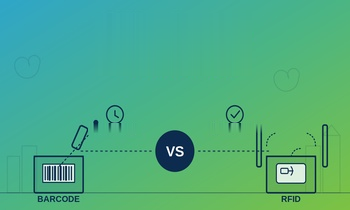
A barcode is read optically: a person or fixed scanner needs a clear line of sight to the label, and it's read one item at a time. An RFID tag is read by radio signal - no line of sight required, and a reader can capture many tags simultaneously, often in the time a single barcode scan takes.
That difference sounds technical, but it's the reason RFID consistently outperforms barcode on the things that actually cost an organisation money and time at scale: speed, accuracy, and the labour required to keep an asset register honest.
Speed and accuracy: where RFID's advantage compounds
This is where RFID earns its reputation. Barcode scanning is inherently one-at-a-time and requires a clean, aimed read - industry sources commonly cite roughly 1-2 seconds per item under manual scanning, with accuracy commonly cited around 95% in controlled conditions, and lower in practice once damaged, obscured, or misaligned labels enter the picture.
RFID removes the line-of-sight bottleneck entirely. Multiple tags can be read at once without being aimed at anything, with well-designed deployments commonly cited in the 95-99%+ accuracy range. In practical terms: verifying a pallet of 200 items by barcode means scanning each one individually; RFID can often capture the same read in seconds, without unpacking or repositioning anything.
For any organisation doing frequent counts, audits, or high-volume movement, this isn't a marginal improvement - it's the difference between tracking being a background process and tracking being a job someone has to stop and do.
Cost: barcode is cheaper to buy; RFID is cheaper to run
Barcode genuinely has the lower price tag upfront, and it's worth being straightforward about that:.png "untitled-design-(21)")
But total cost of ownership tells a different story once labour is in the equation. The unit price of a barcode label is close to irrelevant next to the ongoing cost of paying someone to scan thousands of items by hand, correct the errors that creep in, and chase down assets a barcode-based register simply lost track of. Several industry sources suggest organisations tracking thousands of assets recover RFID's higher upfront cost within 12-18 months through reduced labour time alone - before counting the value of fewer lost assets, faster audits, and a register people can actually trust. That payback period will vary by operation, but the direction is consistent: the more you're tracking, the faster RFID pays for itself.
Durability: built for a working environment
RFID tags are generally more durable than a printed barcode label - they can be embedded or protected in ways a label can't, which matters in any environment with moisture, abrasion, or rough handling. A barcode label that's torn, faded, or covered in grime simply stops working; an RFID tag holds up considerably longer under the same conditions, which is part of why it's the standard choice for high-value or long-lived assets.
The one environment where RFID needs proper planning is around metal and liquid-heavy products, which can interfere with radio signals unless the right tag type and reader placement are specified upfront - a solvable problem with the right site assessment, not a reason to default to barcode.
Where barcode still makes sense
To be fair to it: barcode remains a reasonable choice in a narrower set of situations - very low asset volumes, infrequent audits, extremely tight budgets with no growth on the horizon, or specific RF-unfriendly environments where RFID needs extra specification. If none of your operation looks like that, the case for barcode alone gets thinner quickly.
The realistic path for most organisations: RFID first, barcode where it still fits
Very few mature asset tracking programmes are purely one technology. The pattern that works best in practice is RFID applied to the assets that matter most - high-value, high-volume, frequently audited, or compliance-sensitive - with barcode kept only where its low cost genuinely outweighs the labour and accuracy it costs you. That's not a compromise; it's RFID doing the heavy lifting where it earns its keep, without paying for capability you don't need on your lowest-priority items.
Making the call for your own operation
- How many assets, and how often do you verify them? The more frequently you count, the faster RFID pays for itself.
- What's the cost of a missed or inaccurate read? In regulated or high-value environments, RFID's accuracy advantage is usually worth more than the price difference.
- Where is your current process actually breaking down? If line-of-sight scanning is the bottleneck, that's exactly the problem RFID was built to remove.
- What's your environment like? Metal or liquid-heavy areas need proper tag specification - worth a conversation, not a reason to rule RFID out.
The technology decision ultimately comes down to what level of visibility and control your operation needs going forward, not just what it needs today - and that's usually where RFID has the edge.
Frequently asked questions
Is RFID always worth the higher upfront cost?
For organisations with meaningful asset volume, frequent audits, or compliance requirements, the labour savings and accuracy gains typically justify it within 12-18 months. For very small, static, infrequently-audited asset bases, barcode may remain sufficient.
Can RFID and barcode work together?
Yes, and this is common - RFID for the assets that carry the most value or need the most frequent verification, barcode for the rest. It's a practical way to get RFID's benefits without tagging every low-priority item.
Will RFID work in a facility with a lot of metal shelving or liquid products?
Yes, with the right tag specification and reader placement - this is a standard part of planning an RFID deployment, typically addressed through a site survey rather than something that rules RFID out.
Is RFID more secure than barcode?
Yes - RFID tags are harder to replicate than a printed barcode and can support encoded or encrypted data, which matters for organisations with compliance or security requirements around asset identification.
What's the most common mistake when comparing the two?
Comparing them purely on unit price. The label cost is a small part of the real cost of a tracking programme - labour, accuracy, and audit speed usually matter more, and that's where RFID's advantage shows up.
Posted: Wednesday, 26th August 2026
-(350-×-210px)-(1).png)
-(350-×-210px)(1).png)